
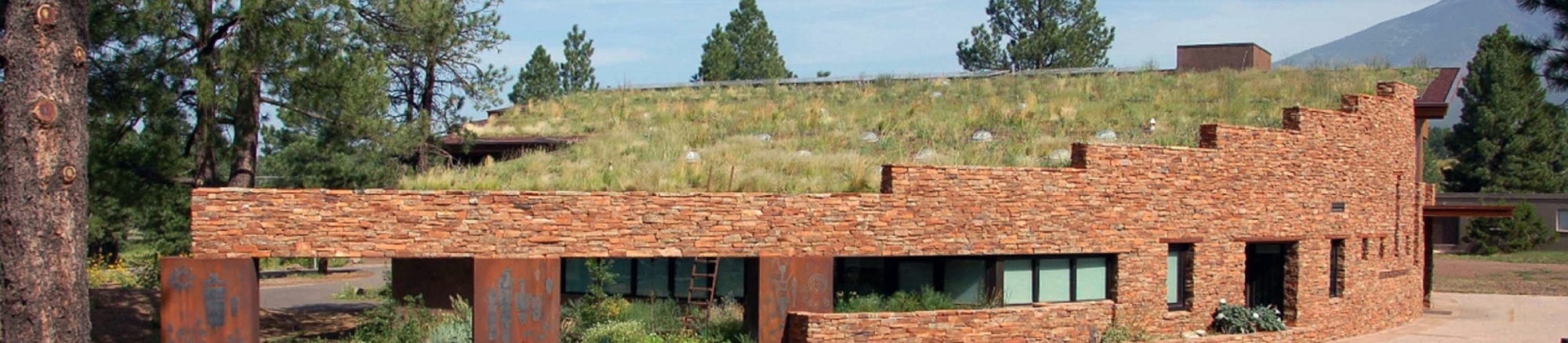
The Museum of Northern Arizona’s 2006 Summer Seminar Series celebrates co-founder Dr. Harold S. Colton’s 125th birthday by focusing on his varied research topics. This series continues a tradition begun by Dr. Colton to foster collaborative multi-disciplinary discussions between scientists, students, and the members of the Flagstaff community and continues with Dr. Colton’s fervor for informal, lively presentations. Seminars begin at 4 p.m. and are included in Museum admission.
June 13—Branigar/Chase Discovery Center
Following Fairy’s Footsteps: Why the Colton’s Moved to Flagstaff
Dr. Harold and Mary-Russell Ferrell Colton left a comfortable life in Pennsylvania to move and settle in rural Flagstaff in 1926—a move that led to the founding of the Museum of Northern Arizona in 1928. MNA Historian Susan Olberding explores the Colton’s story and legacy in this brief biographical overview.
July 11—Branigar/Chase Discovery Center
Potsherds and Prehistoric Population Projections
Dr. Harold S. Colton directed the research program of the Museum of Northern Arizona for over 50 years. He continually synthesized data to build his model of prehsitoric cultural developments of the region, a concept now called “The Black Sand Model.” His method of estimating populations was one of the first such efforts and became influential in later studies of the prehistory of northern Arizona. Since his pioneering work, other methods have been devised to estimate prehistoric populations and improvements continue to be made upon Dr. Colton’s methodology. Peter Pilles, Coconino National Forest archaeologist, discusses the significance of Dr. Colton’s original work as well as more recent estimates of the prehistoric population of northern Arizona.
July 18—Branigar/Chase Discovery Center
Understanding Flagstaff’s Volcanoes
Dr. Colton became enamored with northern Arizona’s variably preserved volcanoes. Wayne Ranney, geologist and MNA board of trustee, explains how Colton developed the first classification schematic for the relative age of these cones. Completed before the age of advanced radiometric dating, Dr. Colton’s observations were not only pioneering, but have withstood the test of time.
August 1—Branigar/Chase Discovery Center
MNA’s Ceramic Repository
Dr. Colton and Lyndon Hargrave founded MNA’s ceramic repository to facilitate consistent identification of ancient pottery in the Southwest. They designed a “Ware and Type” classification system to allow field identification of pottery fragments that provided approximate age, technology, and cultural affiliation of the shards. Dr. Kelley Hays-Gilpin, MNA research associate and NAU professor, demonstrates how MNA is collaborating with NAU students and the Bureau of Land Management to bring the ceramic repository into the twenty-first century.
August 15―Branigar/Chase Discovery Center
Dr. Colton’s “Unity of Science”
Dr. Colton realized how regular intellectual exchanges, in the form of lectures or seminars, could create an inter-disciplinary cooperation between scientists. This interaction produced a meaningful “unity of science” that enabled participants to look up from their disciplinary preoccupations and recognize and support one another’s work. MNA’s Senior Curator of Anthropology David Wilcox explains Dr. Colton’s vision and methods of making MNA a world-class research institution.
The Museum of Northern Arizona in Flagstaff sits at the base of the San Francisco Peaks, the highest mountains in Arizona. As the gateway to understanding the Colorado Plateau, it offers changing exhibits, informative programs, Indian and Hispanic festivals, and custom outdoor adventures that reveal the natural sciences, Native cultures, and artistic traditions of the region.
MNA is three miles north of historic downtown Flagstaff on scenic Highway 180. It is open daily 9 a.m. to 5 p.m. For further information, call 928/774-5213 or visit www.musnaz.org.